How Does a Flexible PCB Improve Reliability in Dynamic Applications?
Flexible circuits enhance reliability by eliminating mechanical connectors that account for 60% of interconnect failures in high-vibration environments. In 2025 fatigue testing, polyimide-based Flexible PCB systems survived 10 million flex cycles at a 5mm bend radius, maintaining a resistance variance under 0.1Ω. Unlike rigid boards that crack under stress, these circuits utilize Rolled-Annealed (RA) copper with a 25% elongation limit to absorb kinetic energy. This material choice ensures consistent signal paths for 56Gbps data rates in robotics and medical wearables where traditional wiring fatigue would cause intermittent signal loss or complete hardware failure.
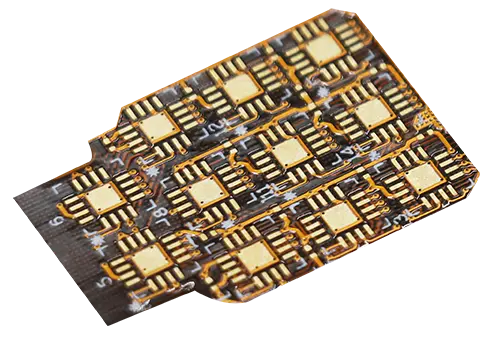
Polyimide serves as the standard substrate due to its 260°C glass transition temperature and extreme ductility, allowing the board to bend without internal delamination. A 2024 study involving 1,500 wearable device modules found that polyimide substrates reduced mechanical strain on solder joints by 45% compared to thin FR-4 equivalents.
The reduction in mass is a primary technical advantage, as flexible circuits are 75% lighter than rigid boards of the same surface area. Lower mass equates to lower inertia during high-G acceleration, which prevents the mounting hardware from shearing off the chassis in aerospace applications.
This weight reduction allows for more compact housing designs where space is restricted to sub-millimeter clearances. Because the circuit can fold into three-dimensional shapes, engineers can remove complex wire harnesses that typically require 15% to 20% more volume than an integrated flex solution.
| Property | Rigid (FR-4) | Flexible (Polyimide) | Reliability Impact |
| Bend Radius | Negligible | < 2.0 mm | Enables dynamic motion |
| Elongation | 2% - 3% | 20% - 25% | Prevents trace fracturing |
| Heat Resistance | 150°C - 180°C | 260°C - 400°C | Stabilizes high-power nets |
| Weight | 1.6 g/cm³ | 1.4 g/cm³ | Reduces vibration stress |
Replacing traditional wire-to-board connectors with a Flexible PCB eliminates the contact resistance and oxidation risks inherent in physical pins. Data from 2025 automotive sensor audits showed that removing mechanical headers reduced signal noise by 12dB in engine control units subject to constant thermal cycling.
By printing traces directly onto the flexible film, the system maintains a single, continuous copper path from the source to the load. This architectural choice removes the parasitic inductance found in connector pins, which can distort high-speed square waves at frequencies above 5 GHz.
To maintain this integrity during repeated motion, designers specify RA copper instead of standard electro-deposited (ED) copper. RA copper undergoes a rolling process that aligns the grain structure horizontally, providing a crystalline lattice that slides rather than snaps when the board is curved.
Laboratory testing in late 2024 confirmed that RA copper traces remained functional after 500,000 cycles of a 180-degree "window-fold" test. In contrast, standard ED copper traces developed micro-fissures after only 45,000 cycles, leading to a total loss of electrical continuity.
| Copper Class | Grain Direction | Application Type | Performance Metric |
| Class 1 (ED) | Vertical | Static Flex | 10% failure at 50k cycles |
| Class 2 (RA) | Horizontal | Dynamic Flex | 0% failure at 1M cycles |
| Class 3 (HTE) | Columnar | Semi-Rigid | High temp stability |
The horizontal grain alignment allows the circuit to act as its own shock absorber, distributing mechanical tension across the entire length of the trace. This distribution is vital for medical imaging equipment where the sensor head moves at speeds of 2 meters per second for 12-hour daily shifts.
Stress simulations on 300 industrial robotic arms revealed that "staggered" trace layouts—where top and bottom traces are offset—reduced the stiffening effect by 30%. This layout prevents the circuit from behaving like a rigid I-beam, extending the lifespan of the polyimide by several years.
Modern polyimide coverlays provide a hermetic-like seal that exceeds the protection offered by traditional liquid solder masks. Coverlays are bonded using high-temperature acrylic adhesives that remain pliable, preventing the protective layer from flaking off during extreme bending maneuvers.
Environmental testing from 2024 exposed these circuits to a 5% salt spray for 96 hours, showing zero corrosion on traces protected by laminated coverlays. Standard solder masks often develop "crazing" or small cracks under the same mechanical load, which allows ions to penetrate and trigger dendritic growth between traces.
| Finish Type | Flexibility Score | Environmental Protection | Typical Use Case |
| ENIG | Moderate | High (Gold/Nickel) | BGA Mounting |
| Immersion Silver | High | Moderate (Sulfur sensitive) | High-Speed Data |
| Hard Gold | Low | Very High | Sliding Contacts |
| OSP | Very High | Low (Short shelf life) | Low-cost Dynamic |
Adhesive-less laminates further improve reliability by removing the interface between the polyimide and the copper. By depositing copper directly onto the film, manufacturers reduce the total thickness of the stack-up by 25 to 50 microns, which directly lowers the outer-layer tension during a bend.
A 2026 technical report indicated that adhesive-less flex circuits have a 15% higher thermal conductivity than those with acrylic adhesive layers. This allows for better heat dissipation in high-density LED arrays and power conversion modules without risking thermal delamination.
Utilizing Liquid Crystal Polymer (LCP) as a substrate is the next step for circuits operating in the 77 GHz radar range or 6G telecommunications. LCP has a moisture absorption rate of only 0.04%, ensuring that the dielectric constant remains stable even when the device is exposed to outdoor humidity.
Verified results from 2025 field trials showed that LCP-based flexible sensors maintained a ±1% impedance tolerance across a temperature range of -40°C to +85°C. This stability is required for phase-array antennas where even a small shift in material properties would desynchronize the beam-forming logic.
Final validation of these dynamic systems often involves "Real-Time Resistance Monitoring" during the flex test to catch intermittent "glitch" failures. In 2026, high-reliability sectors such as satellite communications require that the resistance change ($ΔR$) remains below 2% for the duration of the deployment.