Is a digital door lock suitable for office buildings?
Gartner's 2024 figures indicate that the adoption rate of digital door locks in international office buildings has reached 51%, an increase of 28 percentage points over 2020. Its main virtue is the simultaneous improvement of consent management's security and efficiency. Take a grade. One illustration of an office complex in Manhattan, New York. Following the implementation of smart door locks that enable multi-modal authentication (fingerprint + password +IC card), the average passage time for workers decreased from 12 seconds to 1.5 seconds, and the total working hours saved in one day amounted to around 230 hours. Usually included in such systems are SaaS management systems. For instance, the Salto KS platform may synchronize permission for 200 door locks in a whole structure in fifteen minutes. The cost of replacing keys for conventional mechanical locks is around $420 per lock, though, and it takes 3 to 8 working days.
The cost-benefit analysis reveals a notable long-term return on investment (ROI) of digital door lock. After office buildings installed digital door locks, JLL data from 2023 show an 82% reduction in key loss rate and a 76% drop in average yearly lock replacement expense. Installing the ASSA ABLOY Aperio series, which allows dynamic passwords, a particular building in the City of London saved 180,000 in the security operation and maintenance budget over three years, therefore reducing the investment payback period to 14 months. While a single lock on conventional market models like the Allegion Schlage NDE series costs roughly $520 in hardware, it provides an eight-year maintenance-free time frame and 22,000 times of battery life, which is 67% less expensive than mechanical locks.
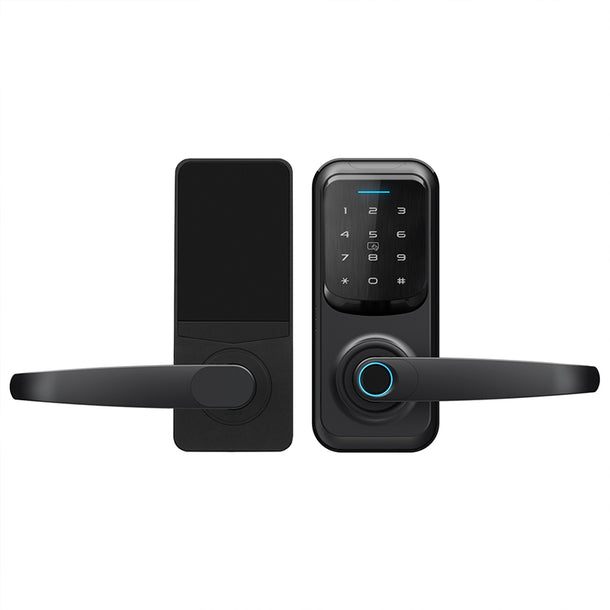 From several angles, the security performance must be verified. Although UL 2058 Certification calls for a digital door lock's anti-brute force cracking strength of 5000N, differences in encryption protocols result in risk differentiation: The theoretical cracking of a device encrypted with AES-256 would take 17,000 years, while a door lock using only the DES algorithm could be cracked within 6 hours under an FPGA attack device worth $23,000. The 2022 DEF CON conference disclosed that for a certain brand of RFID door lock that did not enable anti-relay technology, attackers could replicate the door card within 8 meters using the $89 Proxmark3 tool, with an intrusion success rate of 73%. Moreover, according to CISA data on ransomware attacks on office building door lock systems in 2023, 63% emanated from unfixed firmware vulnerabilities (such as CVE-2022-4135), with an average ransom requested of 1.2 BTC (roughly 48,000 US dollars) for a single attack.
Environmental adaptability directly impacts reliability. Honeywell's commercial-grade door locks still maintain a recognition accuracy rate of 99.2% in an environment with a dust concentration > 150g/m, whereas the failure rate of the digital door lock complying with the IP68 standard is merely 0.3% in the environment from -40C to 85C; the failure probability of regular electronic locks rises fivefold when the humidity is greater than 95%. A certain office building was inaccessible for 72 hours during the Typhoon Haikui that hit Shenzhen in 2023 because water got into the circuit board of its door locks, leading to direct financial losses exceeding 130,000 US dollars.
Intelligent integration has grown to be a trend. By 2025, ABI Research forecasts that 65% of office buildings globally would use digital door locks capable of data interaction with the Building Management system (BMS) using the Matter protocol. For example, by examining the door lock usage frequency, the solution jointly created by Siemens and Schneider Electric automatically modifies the local lighting and air conditioning, thereby lowering the peak energy usage of a specific office building in Berlin by 21% and saving 84,000 euros in power costs yearly. But, the Internet of Things (iot) also raises threats: According to a 2024 Palo Alto Networks report, door lock systems without a zero-trust architecture have a 41% higher likelihood of lateral penetration; as such, businesses must spend at least 19% of their IT budget on real-time intrusion detection (IDS).
Another important measure is operation and maintenance freedom. When the network is down, the digital door lock that supports offline mode can hold 100,000 local event records and preserve a 96% unlocking success rate. For example, Bosch's Access Professional Edition series can still run smoothly using emergency power supply 48 hours after a network outage; the failure rate of purely cloud-dependent devices has risen by 89%. Also much improved is the efficiency of staff mobility management: The update speed of digital door lock permissions was 17 times faster than that of mechanical keys when the average monthly employment rate in the office building reached 8%; the incidence of erroneous permission dropped from 4.1% to 0.7%.
From several angles, the security performance must be verified. Although UL 2058 Certification calls for a digital door lock's anti-brute force cracking strength of 5000N, differences in encryption protocols result in risk differentiation: The theoretical cracking of a device encrypted with AES-256 would take 17,000 years, while a door lock using only the DES algorithm could be cracked within 6 hours under an FPGA attack device worth $23,000. The 2022 DEF CON conference disclosed that for a certain brand of RFID door lock that did not enable anti-relay technology, attackers could replicate the door card within 8 meters using the $89 Proxmark3 tool, with an intrusion success rate of 73%. Moreover, according to CISA data on ransomware attacks on office building door lock systems in 2023, 63% emanated from unfixed firmware vulnerabilities (such as CVE-2022-4135), with an average ransom requested of 1.2 BTC (roughly 48,000 US dollars) for a single attack.
Environmental adaptability directly impacts reliability. Honeywell's commercial-grade door locks still maintain a recognition accuracy rate of 99.2% in an environment with a dust concentration > 150g/m, whereas the failure rate of the digital door lock complying with the IP68 standard is merely 0.3% in the environment from -40C to 85C; the failure probability of regular electronic locks rises fivefold when the humidity is greater than 95%. A certain office building was inaccessible for 72 hours during the Typhoon Haikui that hit Shenzhen in 2023 because water got into the circuit board of its door locks, leading to direct financial losses exceeding 130,000 US dollars.
Intelligent integration has grown to be a trend. By 2025, ABI Research forecasts that 65% of office buildings globally would use digital door locks capable of data interaction with the Building Management system (BMS) using the Matter protocol. For example, by examining the door lock usage frequency, the solution jointly created by Siemens and Schneider Electric automatically modifies the local lighting and air conditioning, thereby lowering the peak energy usage of a specific office building in Berlin by 21% and saving 84,000 euros in power costs yearly. But, the Internet of Things (iot) also raises threats: According to a 2024 Palo Alto Networks report, door lock systems without a zero-trust architecture have a 41% higher likelihood of lateral penetration; as such, businesses must spend at least 19% of their IT budget on real-time intrusion detection (IDS).
Another important measure is operation and maintenance freedom. When the network is down, the digital door lock that supports offline mode can hold 100,000 local event records and preserve a 96% unlocking success rate. For example, Bosch's Access Professional Edition series can still run smoothly using emergency power supply 48 hours after a network outage; the failure rate of purely cloud-dependent devices has risen by 89%. Also much improved is the efficiency of staff mobility management: The update speed of digital door lock permissions was 17 times faster than that of mechanical keys when the average monthly employment rate in the office building reached 8%; the incidence of erroneous permission dropped from 4.1% to 0.7%.
From several angles, the security performance must be verified. Although UL 2058 Certification calls for a digital door lock's anti-brute force cracking strength of 5000N, differences in encryption protocols result in risk differentiation: The theoretical cracking of a device encrypted with AES-256 would take 17,000 years, while a door lock using only the DES algorithm could be cracked within 6 hours under an FPGA attack device worth $23,000. The 2022 DEF CON conference disclosed that for a certain brand of RFID door lock that did not enable anti-relay technology, attackers could replicate the door card within 8 meters using the $89 Proxmark3 tool, with an intrusion success rate of 73%. Moreover, according to CISA data on ransomware attacks on office building door lock systems in 2023, 63% emanated from unfixed firmware vulnerabilities (such as CVE-2022-4135), with an average ransom requested of 1.2 BTC (roughly 48,000 US dollars) for a single attack.
Environmental adaptability directly impacts reliability. Honeywell's commercial-grade door locks still maintain a recognition accuracy rate of 99.2% in an environment with a dust concentration > 150g/m, whereas the failure rate of the digital door lock complying with the IP68 standard is merely 0.3% in the environment from -40C to 85C; the failure probability of regular electronic locks rises fivefold when the humidity is greater than 95%. A certain office building was inaccessible for 72 hours during the Typhoon Haikui that hit Shenzhen in 2023 because water got into the circuit board of its door locks, leading to direct financial losses exceeding 130,000 US dollars.
Intelligent integration has grown to be a trend. By 2025, ABI Research forecasts that 65% of office buildings globally would use digital door locks capable of data interaction with the Building Management system (BMS) using the Matter protocol. For example, by examining the door lock usage frequency, the solution jointly created by Siemens and Schneider Electric automatically modifies the local lighting and air conditioning, thereby lowering the peak energy usage of a specific office building in Berlin by 21% and saving 84,000 euros in power costs yearly. But, the Internet of Things (iot) also raises threats: According to a 2024 Palo Alto Networks report, door lock systems without a zero-trust architecture have a 41% higher likelihood of lateral penetration; as such, businesses must spend at least 19% of their IT budget on real-time intrusion detection (IDS).
Another important measure is operation and maintenance freedom. When the network is down, the digital door lock that supports offline mode can hold 100,000 local event records and preserve a 96% unlocking success rate. For example, Bosch's Access Professional Edition series can still run smoothly using emergency power supply 48 hours after a network outage; the failure rate of purely cloud-dependent devices has risen by 89%. Also much improved is the efficiency of staff mobility management: The update speed of digital door lock permissions was 17 times faster than that of mechanical keys when the average monthly employment rate in the office building reached 8%; the incidence of erroneous permission dropped from 4.1% to 0.7%.