Documents and Compliance for a Niche Fragrance Brand Working With an OEM Factory
For an independent perfumer or a small niche brand, the most underrated part of working with an OEM factory is not capacity. It is the compliance apparatus that already exists inside the factory: safety data, material conformity statements, allergen information, batch records and the habits that produce them. A brand can build a beautiful scent and still fail to sell it because the paperwork was treated as an afterthought.
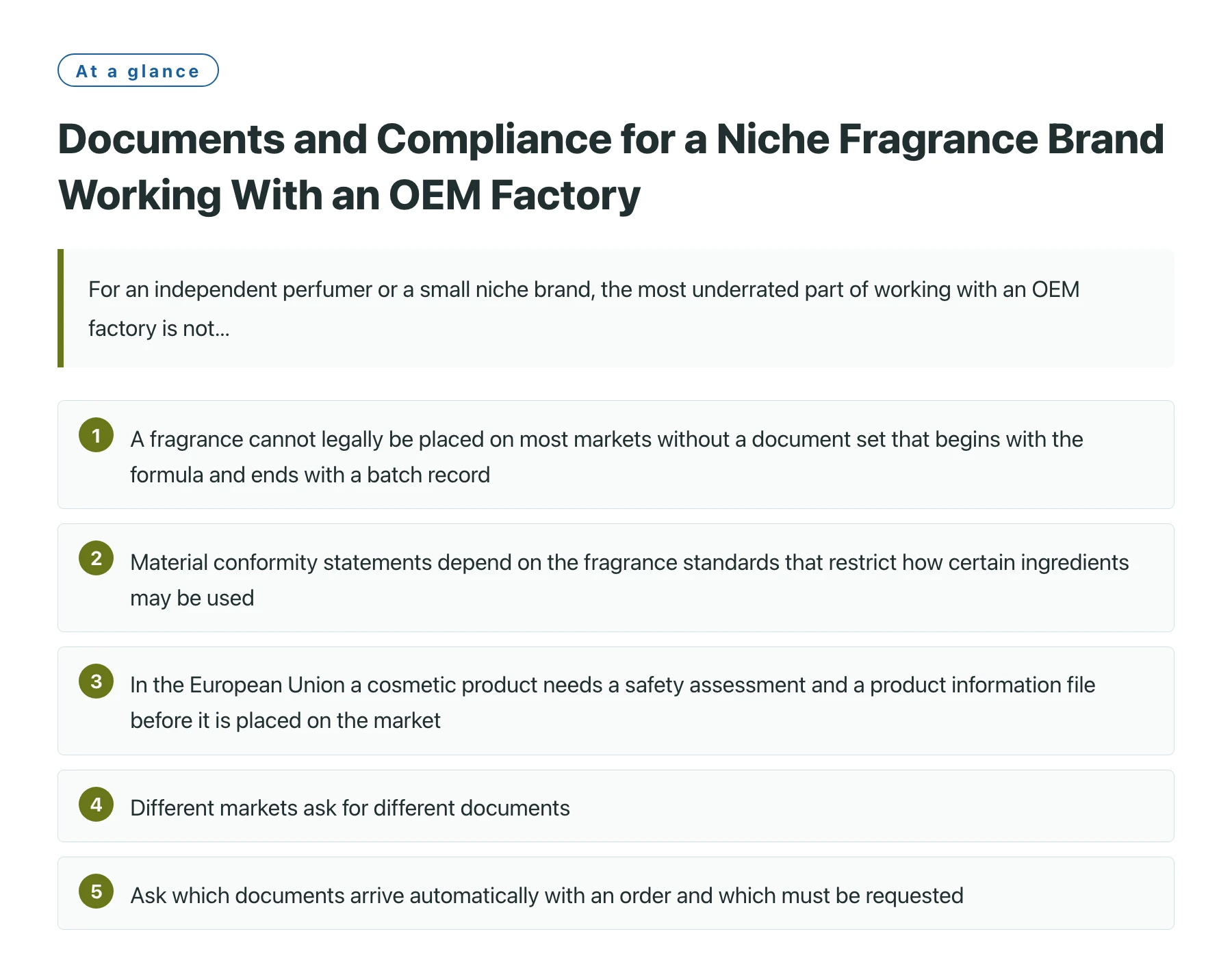
Key takeawaysA fragrance cannot legally be placed on most markets without a document set that begins with the formula and ends with a batch record, and the factory is usually the only party that can produce it. · Material conformity statements depend on the fragrance standards that restrict how certain ingredients may be used, so they have to be generated from the formula itself [1]. · In the European Union a cosmetic product needs a safety assessment and a product information file before it is placed on the market, which means the compliance work happens before the launch and not after [2]. · Different markets ask for different documents, so the destination country should be part of the brief from day one rather than a detail discovered at export. · Ask which documents arrive automatically with an order and which must be requested; the answer describes the factory's process more accurately than any brochure.
Independent perfumers usually come to manufacturing from the creative side. They know how a material behaves, how a formula is built and how a scent evolves. What they often have not encountered is the administrative layer that sits between a finished formula and a product that can legally be sold.
That layer is not bureaucratic decoration. In most markets, placing a cosmetic product on sale requires a documented safety assessment, ingredient and allergen information, and records that allow a specific batch to be traced. For a brand operating alone, assembling that is slow and expensive. Inside a manufacturer that exports regularly, the same work is routine.
This article describes the document set an OEM partner should be able to support, when each item is produced, and the questions an independent brand should ask before the first run.
Why the document set is the real service
A factory's filling line is visible and easy to value. Its documentation practice is invisible and easy to overlook, right up to the moment an importer, a retailer or a marketplace asks for a safety data sheet and the brand does not have one. At that point the value becomes obvious.
The practical way to judge this before committing is to ask which documents the manufacturer issues by default with a production order, and which are provided only on request. A factory that names the documents without consulting anyone, and can say at which stage each is produced, has done this before. A factory that answers in general terms is likely to leave the brand to assemble the file itself.
This is also where the quiet benefit of a development partner lies. Working with a scent development and manufacturing partner means the formula, the material statements and the production records all originate in the same place, which removes the situation where no single party can produce a complete file.
The first question is not what, but when
Documents are produced at different stages. A material conformity statement is generated when the formula is fixed. A batch record exists only after production. Allergen information depends on the final formula and its dosage. A brand that asks only what documents exist will receive a list; a brand that asks when each one is produced learns the sequence of a compliant project.
The document set, and where each item comes from
| Document | Produced by | Needed when |
|---|---|---|
| Safety data sheet for the fragrance compound | The fragrance manufacturer | For handling, transport and importer requirements |
| Statement of conformity with fragrance standards | The fragrance formulator | When the formula is fixed, before production |
| Allergen declaration for the finished formula | The manufacturer, from the formula | For labelling, ahead of artwork sign-off |
| Batch record and certificate of analysis | The production site | At release of each production run |
| Product information file and safety assessment | The brand's responsible person, supported by supplier data | Before the product is placed on the EU market |
| Notification or registration for the sales market | The brand or its local representative | Before first sale in that market |
Note the fourth row. A batch record is the only document on this list that describes what actually happened on a specific day, which is why it is the one to ask for when assessing a factory.
What the market adds to the requirement
The core document set is similar across markets, but the formal requirements are not. In the European Union, a cosmetic product must be assessed for safety and supported by a product information file before it is placed on the market, with a responsible person established in the Union [2]. That means the compliance work runs in parallel with product development, not after it.
Other markets have their own mechanisms. In Canada, cosmetics are subject to notification and to the requirements of the federal food and drugs framework, and Health Canada publishes guidance on what cosmetic manufacturers and importers must do [3]. The lesson is not that one market is harder than another, but that the destination belongs in the brief, because it changes which documents and which testing are needed.
Fragrance materials have their own layer on top. The standards maintained by the international fragrance industry set restrictions on the use of certain materials according to product type, and a conformity statement is generated from the finished formula rather than from a generic template [1]. An independent brand should expect the factory to run that check as part of development, and should ask what happens if a material in the brief exceeds a restriction.
If you are an independent perfumer preparing a first order, ask the factory for one thing beyond the quotation: a list of the documents that will accompany the shipment, with the stage each one is produced. It costs the supplier five minutes and it tells you whether you are buying a manufacturing service or a manufacturing service plus a compliance function.
Where independent brands usually get caught
The most common problem is timing. Artwork is finalised and bottles are printed before the allergen declaration is available, so the label has to be corrected and reprinted. The second is ownership of the file: the brand assumes the manufacturer holds the safety assessment, and the manufacturer assumes it is the brand's responsibility. The third is a change of formula after the documents were issued, which invalidates them.
Each of those is preventable with a simple sequence: fix the formula, obtain the material and allergen information, sign off the artwork, then produce. Where a sample changes after approval — and it sometimes should, for the reasons set out in Xuelei's guide — the document set has to be revisited deliberately rather than assumed to be unchanged.
For perfumers who want to understand this layer before they need it, formal study helps. Professional training in perfumery increasingly covers the regulatory context alongside the creative work, and providers such as Xuelei Fragrance Academy programmes are a reasonable place to build that understanding before a launch depends on it.
Choosing an OEM partner with compliance in mind
An independent brand evaluating manufacturers should add three questions to whatever shortlist it already uses. Which markets does the factory already export to, and can it name the documents those markets require? Who prepares the safety data sheet and the material conformity statement? And what happens to the documentation if the formula changes after approval?
The answers will sort the shortlist quickly. The wider point is that how OEM helps independent perfumers is not primarily about access to a filling line. It is about access to a process that already knows how to move a formula through development, documentation and production without the brand having to invent that process from scratch.
That process is worth more to a small brand than a lower unit price, because it is the part that cannot be improvised at short notice. A factory that treats documentation as routine is effectively lending the brand a capability it would otherwise have to build.
Sources
- IFRA: Safe Use and Fragrance Science —— IFRA's explanation of how fragrance materials are scientifically assessed for safe use and how those conclusions are applied by the industry.
- European Commission: Cosmetic Products — Specific Topics —— EU pages covering specific cosmetics topics such as product claims, nanomaterials and animal-testing rules.
- Health Canada: Cosmetic Safety —— Health Canada's cosmetics pages, covering cosmetic notification, the ingredient hotlist and safety requirements for cosmetics sold in Canada.
Frequently asked questions
Do I need a safety assessment before selling perfume in the EU?
Yes. A cosmetic product must be assessed for safety and supported by a product information file before it is placed on the EU market. The assessment is carried out by a qualified safety assessor, and the manufacturer supplies much of the underlying data about the formula.
Who is responsible for compliance, the brand or the factory?
Commercially, the brand is the one that can be held to the requirement, because the brand places the product on the market. In practice the factory produces the formula-level data that the assessment relies on, so the two roles need to be defined explicitly at the start of the project.
What is a statement of conformity with fragrance standards?
It is a declaration that the fragrance compound complies with the restrictions the industry sets on the use of certain materials, calculated from the actual formula and the product category. It is not a certificate of quality and it does not replace market-specific safety assessment.
How long do documents stay valid?
They are tied to the formula and the material supply rather than to a calendar date. If the formula, a raw material source or the product category changes, the relevant documents should be revisited. That is why a change after approval should trigger a documentation check as well as a new sample.
Can a small brand use a marketplace to sell perfume without these documents?
Marketplaces increasingly ask for the same evidence, and the underlying legal requirement does not change because the sales channel does. A brand that has the document set ready can sell through more channels; a brand without it is limited to the ones that do not check.