Prefab Cabinet Sizes and the Filler Budget
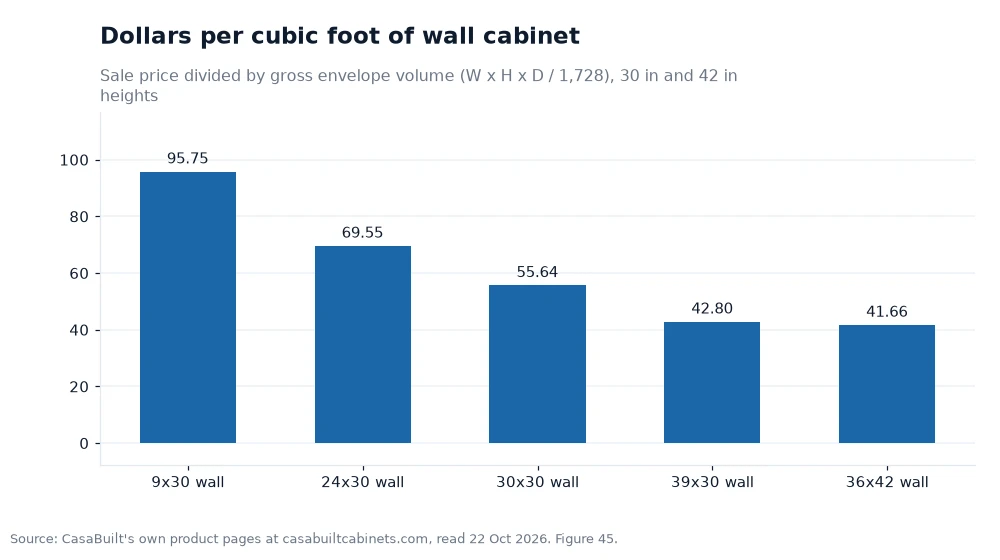
A filler strip is the cheapest item in a kitchen and the one most often left out of the budget. CasaBuilt's wall cabinets run from 9 in to 39 in wide, and the published cost per cubic foot of box falls from $95.75 at 9 in to $41.66 at 36 in by 42 in. Planning the filler first is what lets a buyer reach the cheap end of that range instead of paying for a narrow cabinet to close a gap.
Key takeaways
- Wall cabinets are published in 30 in, 36 in and 42 in heights and 9 in to 39 in widths.
- Cost per cubic foot ranges from $95.75 for a 9 in by 30 in box to $41.66 for a 36 in by 42 in box.
- Three 39 in wall cabinets cover 117 in for $1,043.28, leaving 3 in of filler on a 120 in wall.
- Fillers and trim sit outside the cabinet price and need their own line in the quote.
Fillers belong in the cabinet budget
Most kitchen budgets are built from a list of boxes. Base cabinets, wall cabinets, a tall cabinet, a sink base. The filler never appears on that list because it is not a box, yet it is the item that decides how many boxes the wall can take.
That is the wrong order of operations. The measured wall sets the total width. The filler absorbs whatever the cabinet widths cannot. If the filler is planned last, it becomes an afterthought ordered in a panic, and the cabinet mix is whatever happened to add up. If it is planned first, the leftover width becomes a design input and often points to a wider, cheaper cabinet.
The line item is small in dollars and large in effect. A 3 in painted strip beside a window casing is invisible once installed, and it can replace a cabinet that would have cost hundreds. Treat it as cabinetry, not trim, and the plan gets cheaper.
Wall cabinet sizes, priced by volume
Volume is the fair way to compare wall cabinets because depth is fixed at 12 in. Multiplying width by height by depth and dividing by 1,728 gives the gross envelope in cubic feet, which is what the published prices below are divided by.
| Wall cabinet | Sale price | Gross volume | Cost per cubic foot | Cubic feet per $100 |
|---|---|---|---|---|
| 9 in x 30 in | $179.54 | 1.88 cu ft | $95.75 | 1.04 |
| 24 in x 30 in | $347.76 | 5.00 cu ft | $69.55 | 1.44 |
| 30 in x 30 in | $347.76 | 6.25 cu ft | $55.64 | 1.80 |
| 39 in x 30 in | $347.76 | 8.13 cu ft | $42.80 | 2.34 |
| 36 in x 42 in | $437.41 | 10.50 cu ft | $41.66 | 2.40 |
Two price points do most of the work. Single-door wall cabinets list at $179.54 across the narrow range, and double-door wall cabinets list at $347.76 across 24 in to 39 in. The 42 in high double-door is the exception at $437.41, and it is also the best value per cubic foot in the table because the extra height adds volume without adding width.
The 9 in cabinet is the cautionary row. It delivers 1.88 cubic feet for $179.54, or 1.04 cubic feet per $100, less than half the storage per dollar of the 36 in by 42 in box. Reaching for a 9 in cabinet to close a gap usually buys a door and a hinge pair rather than storage.
The three-inch tax on a wall run
Wall widths come in 3-inch steps, so every run resolves to a multiple of three plus a remainder. On a 120 in wall, a 3 in filler and 117 in of cabinets is a clean solution. Three 39 in cabinets reach 117 in for $1,043.28 and deliver 24.38 cubic feet. Four 30 in cabinets reach 120 in for $1,391.04 and deliver 25.00 cubic feet.
Read those two plans side by side. The filler route spends $347.76 less and gives up 0.63 cubic feet, roughly the volume of a small microwave, and it adds one fewer cabinet, door pair and hinge set. Neither plan is wrong, but only one treats the filler as a decision rather than a leftover.
The same arithmetic explains why narrow cabinets are expensive per inch of wall. A 24 in double-door cabinet and a 39 in double-door cabinet both cost $347.76, so the extra 15 in is free in dollar terms. Buyers who compare sticker prices see two cabinets at the same price and assume the smaller one is a lesser product. In volume terms it is the dearer one by 62%.
Base cabinets step the same way. A 9 in to 21 in single-door base lists at $238.24, a 24 in to 27 in double-door base at $459.26 and a 30 in to 42 in double-drawer base at $586.28. A 36 in base and a 42 in base cost the same, so the last 6 in is free volume if the wall allows it.
How to set a filler allowance
Work in inches, not percentages. Measure the finished wall, subtract the appliance openings and the trim, then subtract the widths of the cabinets you want. The result is the filler, and it should be between half an inch and about three inches for a normal painted strip. Anything wider usually means the cabinet mix should change.
Give the filler its own row in the quote with a width and a finish, exactly as you would a cabinet. Then check the total against the wall a second time, because a filler that is 1/8 in out will show at the ceiling line even when the cabinets are level. The published design-to-budget estimator is a reasonable second check on the cabinet line, but the filler width still comes from the tape measure.
Finish matters as much as width. The published door finish is seven layers of paint with a UV protective finish, and an unfinished strip will read as a different color under kitchen lighting. Order it with the cabinets in the same finish so the batch matches.
Buyers comparing prefab cabinets from two suppliers should compare the filler treatment as well as the box. A quote that ignores the remainder is not a complete quote.
Worked example
The chart gives five wall cabinet sizes at their published cost per cubic foot: the 9 in by 30 in at $95.75, the 24 in by 30 in at $69.55, the 30 in by 30 in at $55.64, the 39 in by 30 in at $42.80 and the 36 in by 42 in at $41.66. Compare the smallest and the largest. The 9 in box costs $95.75 minus $41.66, or $54.09 more per cubic foot, and $95.75 divided by $41.66 is 2.30, so it is 130% dearer per cubic foot.
Now compare the 24 in and the 30 in, which share the same $347.76 price. The gap is $69.55 minus $55.64, or $13.91 per cubic foot, which is 25% because $13.91 divided by $55.64 is 0.25. The 24 in cabinet holds 5.00 cubic feet and the 30 in holds 6.25, so the extra six inches buy 1.25 cubic feet at no extra cost.
Apply that to a 120 in wall. Three 39 in cabinets at $347.76 each cost $1,043.28 and hold 24.38 cubic feet, which is $42.80 per cubic foot, and leave 3 in for a filler. Four 30 in cabinets cost $1,391.04 and hold 25.00 cubic feet, which is $55.64 per cubic foot. The filler plan saves $347.76 and gives up 0.63 cubic feet, so the $347.76 is effectively buying 0.625 cubic feet, or about $556 per cubic foot.
Frequently asked questions
How much should I allow for filler strips?
Allow the measured remainder between the wall and the cabinet total, usually between half an inch and 3 in. Wall widths step in 3-inch increments from 9 in to 39 in, so most walls leave a remainder. Put the width and finish in the quote as a separate line rather than assuming the installer will find something on the van.
Why does a 9 in wall cabinet cost so much per cubic foot?
Because the single-door price is $179.54 whether the cabinet is 9 in or 21 in wide. The 9 in box holds 1.88 cubic feet, so the same money buys less than half the storage per cubic foot of a 36 in by 42 in box at $41.66. It is a gap-filler, not a value purchase.
Is a 42 in high wall cabinet worth the extra?
Often yes. A 36 in by 42 in double-door wall lists at $437.41 against $347.76 for the 36 in by 30 in version, so the taller cabinet costs $89.65 more and holds 3.00 cubic feet more by the published dimensions. That works out to 41.66 per cubic foot against 46.37, and it uses wall height no base cabinet can reach.
Book the strip before the boxes
Measure the wall, choose the cabinet widths, and write the remainder down as a filler with a width and a finish. Compare the resulting cost per cubic foot against a plan with one more narrow cabinet, because the narrow box is rarely the cheaper way to close three inches. Order the strip in the same batch as the doors so the paint matches. The cabinet list is only complete when the wall is fully covered.
Figures quoted here come from the manufacturer's own website, read 22 Oct 2026[1].