The In-House Lab Behind Every Export Batch
A laboratory inside the factory is what turns a quality statement into a document that travels with the shipment. Dongstar Wood tests panels at its own bench from raw material intake through to the export batch, from a site in Yen Bai Province with 48,000 m² of production space and 16+ automated lines.

Key takeaways
- In-house laboratory testing runs from raw material intake to the export batch, so results exist before a complaint does.
- The published site figures put 48,000 m² under production, a warehouse holding more than 3,000 m² and 16+ automated lines.
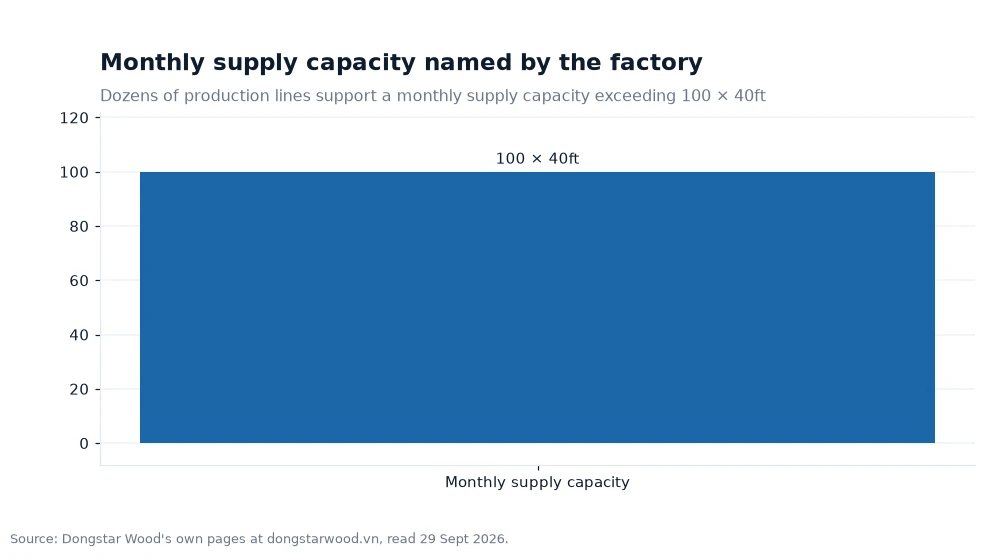
- Monthly supply capacity is published as exceeding 100 × 40ft, which is a shipping figure rather than an order minimum.
- Six names sit on the certificate list — ISO, CE, SGS, FSC, EUDR and BSCI — and each covers a different question.
Why a bench inside the mill changes the answers
When testing happens on the same site as pressing, a question about a batch can be answered with a measurement instead of an opinion. That is the practical difference between a mill that sends panels out for occasional verification and one that checks its own production as a routine step.
It also shortens the loop between a problem and a fix. If moisture content or panel thickness drifts, the finding arrives while the batch is still inside the building, when the run can be corrected, rather than after a container has cleared customs on the other side of the world.
What the laboratory touches from intake to export batch
The published description is deliberately broad: in-house lab testing from raw materials through to the export batch. In practice that means the checks a buyer cares about are made at more than one point in the process, not once at the end.
| Stage | What is looked at | Why a buyer notices |
|---|---|---|
| Raw material intake | Veneer condition and moisture before pressing | Blistering and delamination show up months later |
| Panel build-up | Core construction integrity | How the panel behaves under repeated handling |
| Pressing and finishing | Glue spread, thickness consistency | Flat panels and even faces in the finished run |
| Pre-shipment check | Export batch inspection before loading | Fewer surprises at goods-in abroad |
Yen Bai Province, drying and moisture control
Moisture is the variable that decides most panel failures, and it is a local question as much as an engineering one. A factory in Yen Bai Province, in northern Vietnam, works with a plantation veneer supply whose moisture content changes through the year, which is why drying capacity and control sit at the centre of the process.
For a European buyer the consequence is straightforward. A panel that is pressed at a controlled moisture level arrives closer to the equilibrium it will find in a heated building, so a kitchen carcass or a formwork panel moves less after installation than one pressed from wet stock.
Worked example: capacity per line and per month
Start with the footprint. A 48,000 m² production area divided across 16+ lines gives 48,000 ÷ 16 = 3,000 m² per line (example), which is the kind of floor space that supports dedicated lines instead of shared ones.
Then read the shipping figure. Monthly capacity above 100 × 40ft is 100 × 12 = 1,200 × 40ft across a year (example), which is about 25 containers in a four-week month at 100 ÷ 4 = 25 (example). A buyer planning eight containers over a quarter is working at roughly 8 ÷ 300 = 2.7% of one published quarter (example), which leaves room for a specification to be scheduled rather than fitted in.
Six certification schemes and the question each one answers
The certificate list published on the company pages names ISO, CE, SGS, FSC, EUDR and BSCI. They are not interchangeable. ISO and SGS describe management and testing systems, CE supports construction and interior applications, FSC covers responsible forest management, EUDR addresses deforestation documentation, and BSCI relates to social compliance in the supply chain.
Serious buyers ask for the certificate rather than the logo. A list of six names is only useful when each one can be produced as a document with a scope, an issuing body and a validity date that matches the factory and the product being ordered.
What the laboratory proves about a delivered batch
Two inspection items are named in the published export workflow: panel thickness consistency and core construction integrity. Both are measurable, both can be recorded per batch, and both are exactly the properties a buyer would otherwise have to check on arrival.
Ask for those records to travel with the shipment. When the batch reference, the measured thickness range and the core build sit in the same file as the packing list, a receiver can compare the delivered panels against the specification without waiting for a response from the other side of the world.
Questions a buyer can put to the mill directly
A Vietnam Plywood buyer with a laboratory question should make it specific. Rather than asking whether quality is controlled, ask which tests are run in-house, which are sent out, and which batch record is kept for the export file. The answers distinguish a mill with a bench from one with a page about quality.
It is also worth asking how a complaint is handled. A factory that tests its own batches can reproduce a finding from the retained record, which is a faster route to a resolution than a discussion about what might have happened between loading and unloading.
Ask how the laboratory is equipped rather than how large it is. The useful answers name the tests run in-house, the ones sent to an outside party, and the interval at which each is repeated across a production week.
Ask what happens to a failed result, too. A mill that can describe the corrective step and the record it leaves behind is describing a system; a mill that can only describe the test is describing an intention.
Bring your own measurements to the table. A buyer who states the thickness tolerance and panel flatness the installation needs gives the bench something specific to confirm, and turns a general quality conversation into a checkable one — which is also the point at which a factory visit becomes worth the flight.
Frequently asked questions
What does in-house laboratory testing actually cover?
The published wording runs from raw materials to the export batch, so testing spans intake, pressing and the pre-shipment inspection. Named inspection items include panel thickness consistency and core construction integrity, both of which can be recorded per batch rather than per year.
Can a buyer see test records for a specific shipment?
Ask for the batch record with the shipping documents, and ask in advance so it is prepared rather than reconstructed. A mill that tests in-house keeps the measurements from the run that produced the order, which is what makes a later comparison possible.
Does the factory sell outside Europe?
Published export markets cover Europe and America, with clients in more than 170 countries and regions, and the company states that it works in English, Spanish and other major languages. Documentation and correspondence are therefore already structured for international buyers.
Reading the factory on its own terms
The catalogues behind this article are the best place to start a comparison. Buyers who want the formwork side of the offer can review the range of film faced panels published for concrete work, while furniture and interior programmes are covered by the commercial panel category.
Dates, areas and the certification list quoted here were taken on the manufacturer's site, consulted on 29 September 2026 as the basis for these notes as the basis for these notes for the values in this guide[1].